Form follows algorithm
Interview: Simon Vorhammer in conversation with Jasmin Jouhar


Simon Vorhammer
How would you explain what an algorithm is to someone unfamiliar with the topic?
An algorithm does not necessarily have anything to do with computers. At its core, it is a set of instructions and conditions designed to achieve a specific result. Long before computers existed, algorithmic principles were already being applied, for example in nineteenth-century crystallography. In his System of Mineralogy (1837), James Dwight Dana described methods by which crystals could be constructed geometrically. These procedures followed clearly defined rules: axis ratios, planes of symmetry and angles determined how a form had to be built up step by step. The draftsman followed a fixed sequence of actions, essentially an algorithm on paper, carried out by a human being. For Formfeld surfaces, we use algorithms that are executed by computers. The advantages are obvious: computers are many times faster.

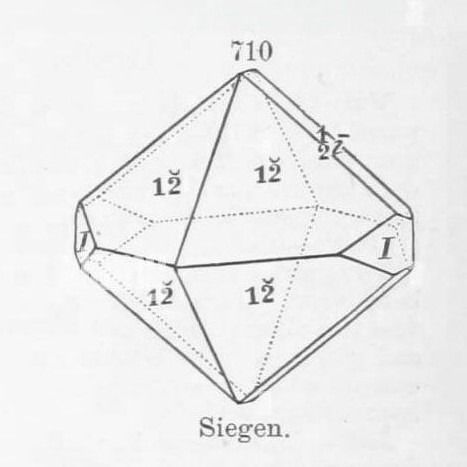

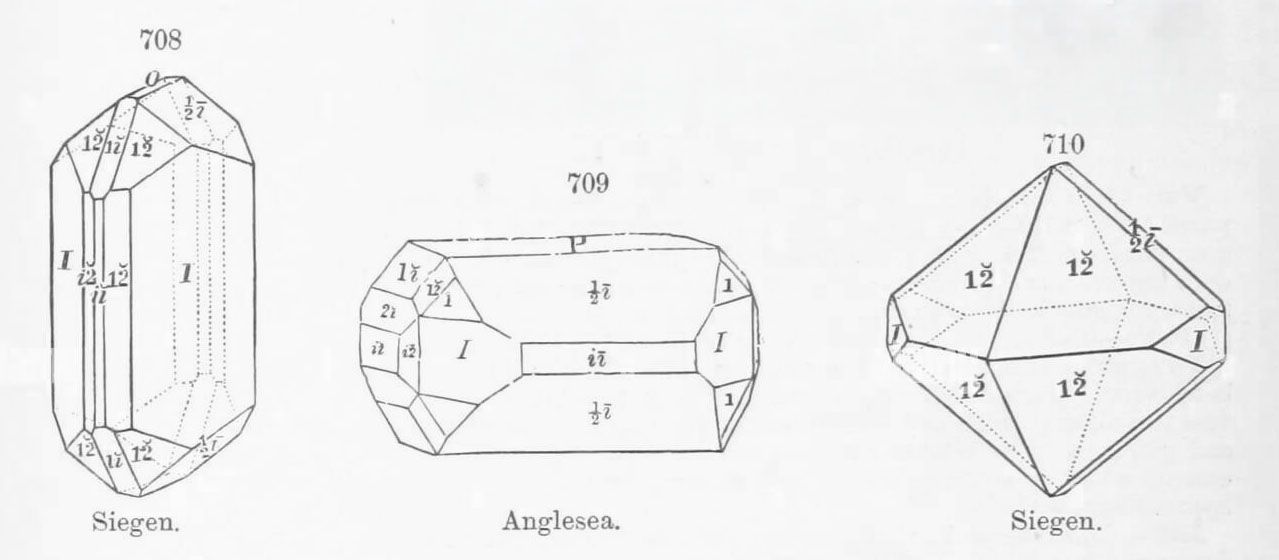
James Dana – System of Mineralogy (1837)
What defines an algorithm?
An algorithm always involves a triad of input parameters, functions and result. These three aspects are inseparably linked. If two of them remain unchanged, the third does not change either. Put differently, if the same input parameters pass through the same function, they will produce the same result. This principle is called determinism. Algorithms are not magical, self-thinking systems that we can simply set in motion and leave to their own devices. They are machines that stoically carry out the tasks assigned to them. What those tasks are is something we have to define. At the same time, the complexity of those tasks can be so great that the outcome may be unpredictable and surprising.

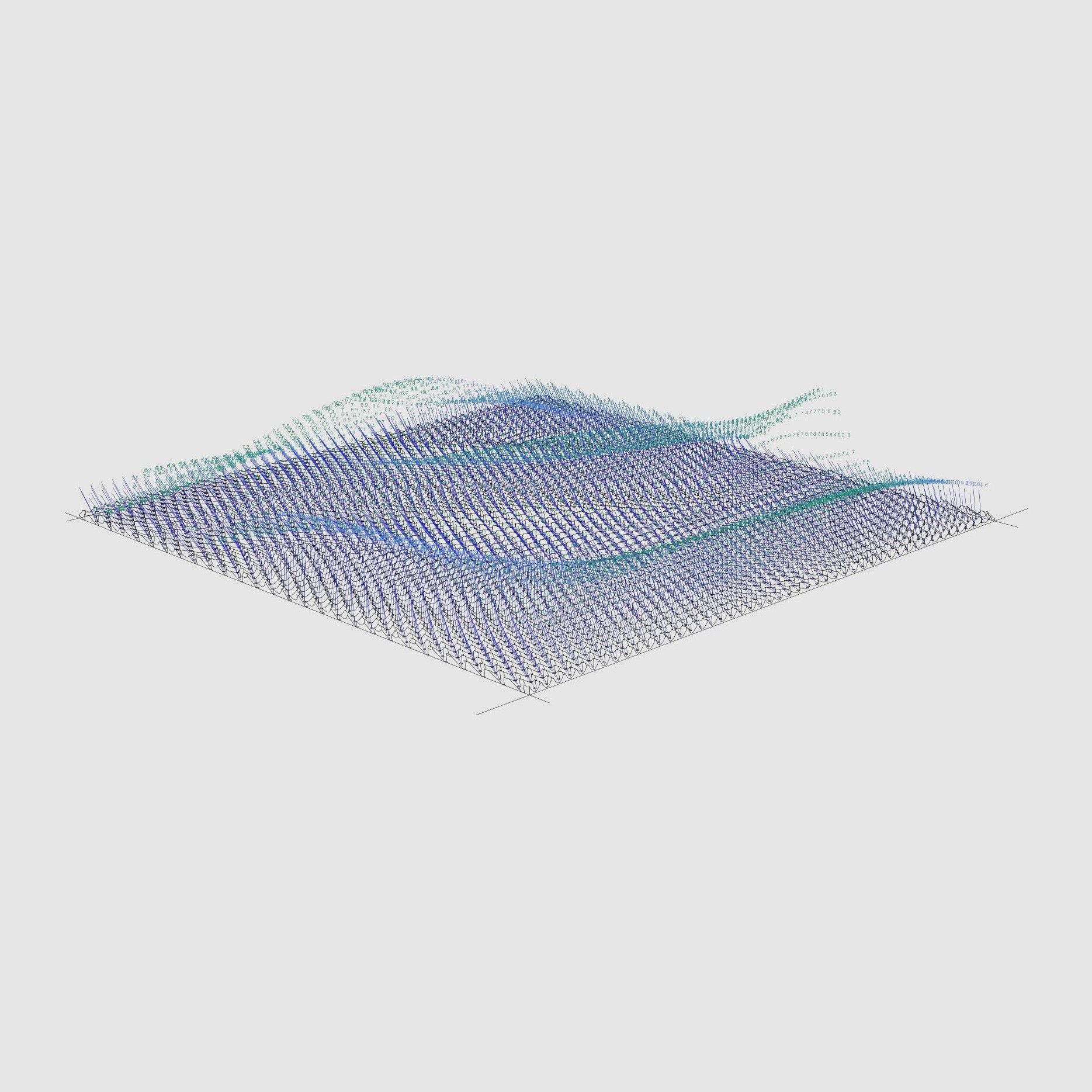

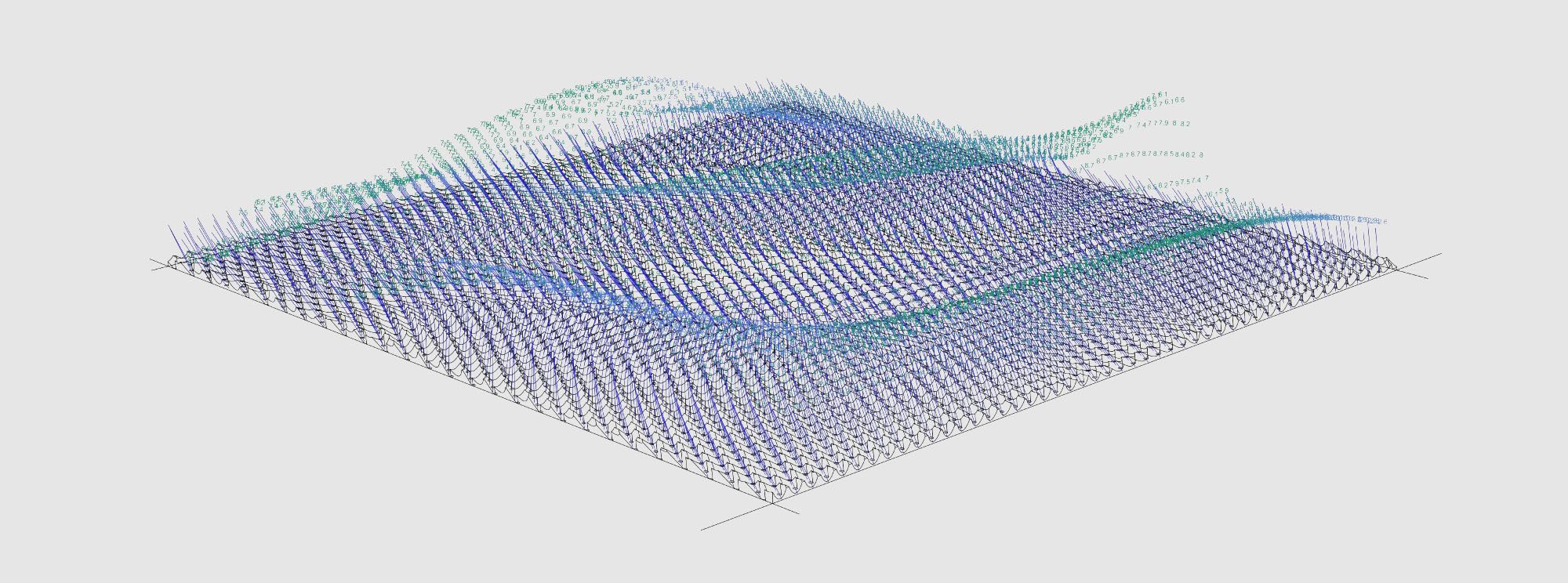
Visualisation of a Formfeld Algorithm
How do you write an algorithm?
At the beginning, there is the idea of a Formfeld structure with certain visual and geometric properties. The algorithm itself usually takes shape almost automatically in my mind. At the same time, an image begins to form of which steps on the computer might be necessary to get there. I first sketch out this logic in the form of a diagram. That prevents me from rushing too quickly into programming and ending up in a dead end. Once the conceptual framework is on paper, I begin translating it into the computer.
For this, I work almost exclusively with the visual programming language Grasshopper for Rhino. In this context, visual means that one does not program in text form, but instead works with a graph: individual functional components are linked together through logical connections on something like a whiteboard. In this way, a visual network emerges that maps the sequence of the computation.
The entire design process is iterative. You start with an idea and gradually translate it into a logical structure. At this stage, the algorithm is usually not yet fully developed, but it already produces an initial result that can be tested and evaluated. If that result is not convincing, I return to a particular point and branch off in a new direction from there. Sometimes, however, you also have to go all the way back to the beginning and pursue an entirely different approach.
For this, I work almost exclusively with the visual programming language Grasshopper for Rhino. In this context, visual means that one does not program in text form, but instead works with a graph: individual functional components are linked together through logical connections on something like a whiteboard. In this way, a visual network emerges that maps the sequence of the computation.
The entire design process is iterative. You start with an idea and gradually translate it into a logical structure. At this stage, the algorithm is usually not yet fully developed, but it already produces an initial result that can be tested and evaluated. If that result is not convincing, I return to a particular point and branch off in a new direction from there. Sometimes, however, you also have to go all the way back to the beginning and pursue an entirely different approach.

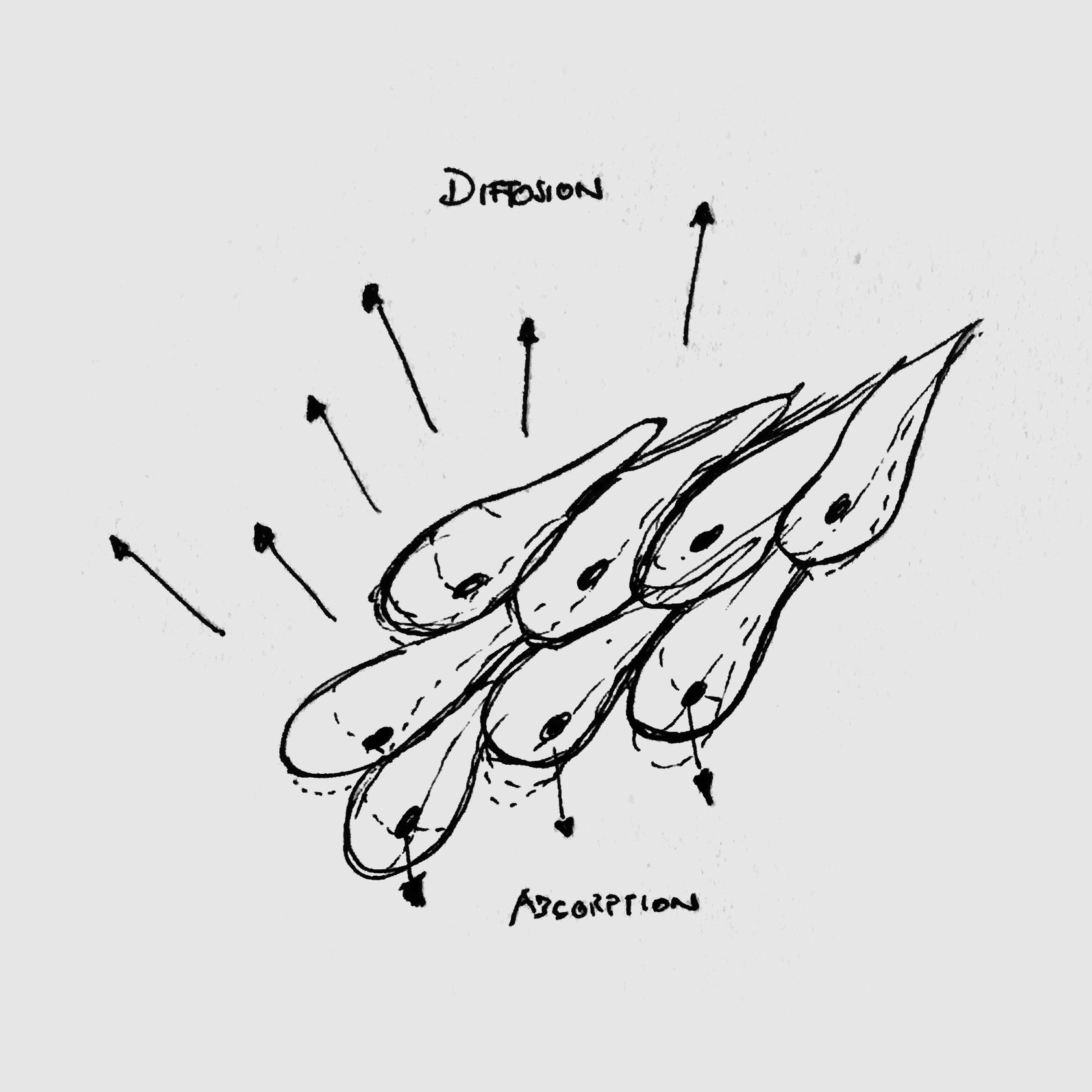

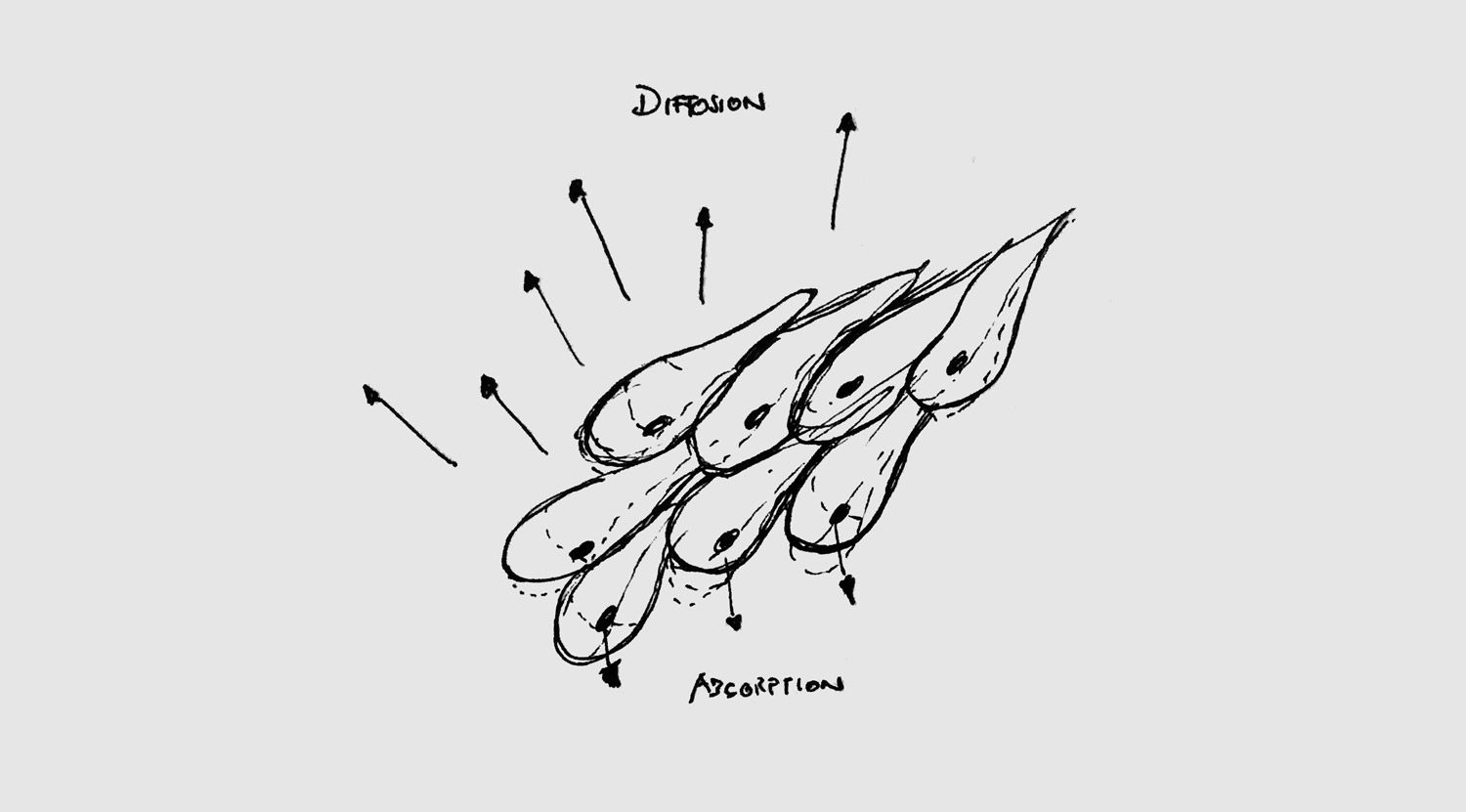
Concept sketch for Formfeld 1
How long does the process take?
It varies greatly. The duration depends on the complexity of the geometric structure. Once you have found a direction that leads to a convincing result, the devil is usually in the detail. An algorithm that works for a small surface can suddenly create entirely new problems when applied to a larger one. That is when the work on performance begins: simplifying, accelerating, making it more robust. The code for a structure can be developed within a day or it can take a month. There is no question that the whole process is complex, even if the final result often appears entirely natural and simple.
Take the Formfeld 1 relief, for example: two panels of this structure are similar, but never identical.
Behind this are two questions: why are the panels never the same, or why would one want them never to be the same? The two are closely connected. The Formfeld 1 structure was developed with the aim of creating a fluid, vortex-like geometry that does not repeat itself at any point. It is well established psychologically that people value unique objects. Uniqueness is associated with authenticity, individuality and identity. In an environment of standardized products, this creates a form of value that is less material than symbolic. In CNC fabrication, it makes no difference whether one produces an identical relief or a different one. The production of unique pieces is not a question of effort, but a conscious decision. One could say: the panels are never the same because they are not meant to be, and because it is possible to make them different.

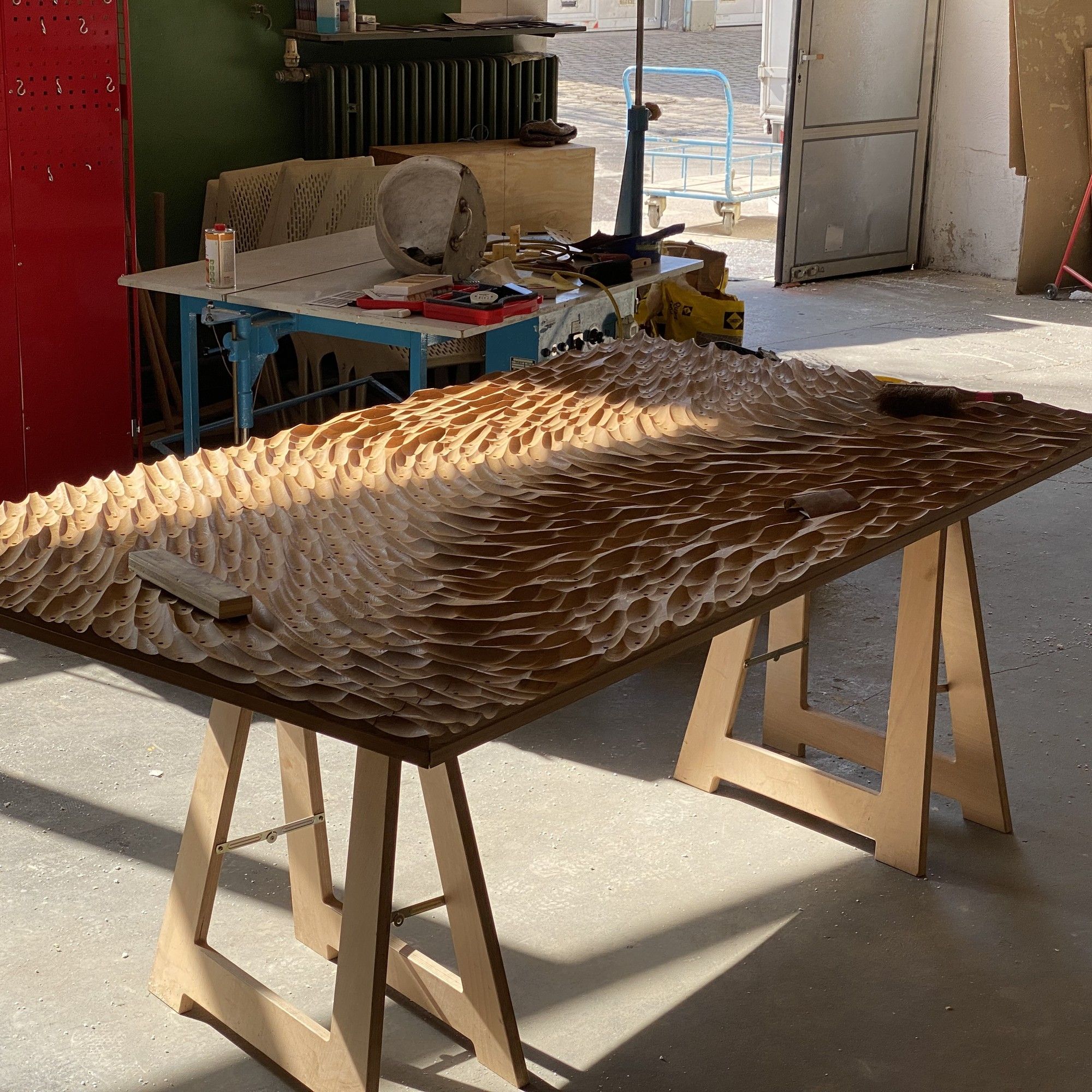

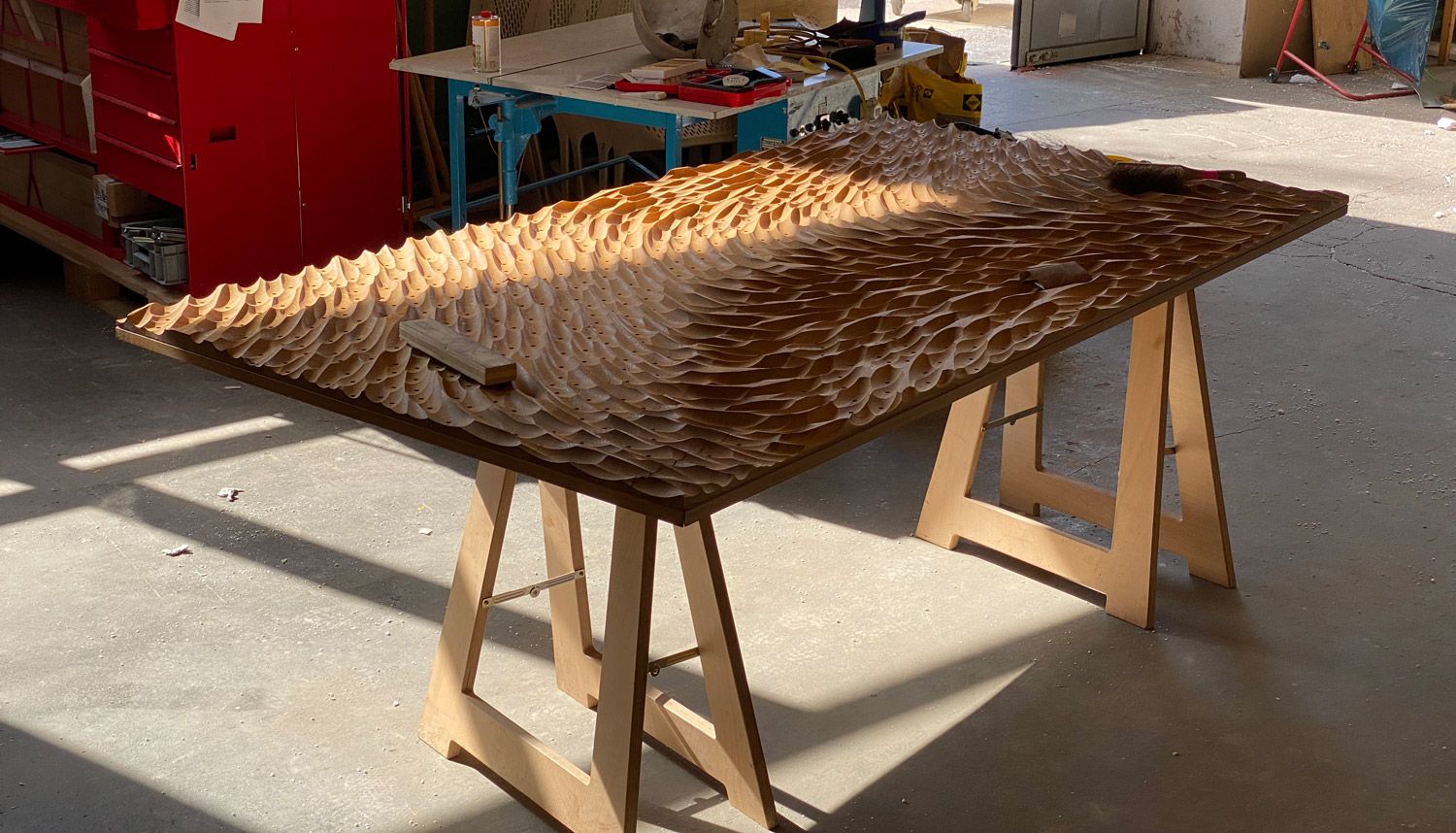
A Formfeld 1 panel in the making
Is this something that happens automatically, or do you guide the process yourself?
The process is not entirely automatic. We control the input parameters, meaning the values that determine how the structure develops across a surface. These parameters differ for each surface or panel, depending on its format, size and geometry. What matters most is the primary direction of movement within the structure. Which structure suits which surface cannot be calculated. This is not a question of physics, but a highly subjective decision. The algorithm cannot make that decision. It merely executes what it is told to do. The real work lies in adjusting these parameters until the structure is in harmony with the surface, the material, the space and the direction of light.
This also means that we can individualize the panels. The ceiling in the House R project, for example, is based on the Formfeld 1 structure, but it was adapted specifically for that project. Together with the client, the idea emerged that the structure should taper off gently towards all sides so that it would integrate into the smooth roof surfaces.
Working on the algorithm
What inspired you to design surfaces using algorithms?
I have been working with algorithmic methods for a good fifteen years, initially mainly in the field of temporary and brand-related architecture. The first algorithmically designed surface was created in 2016 for Blitz Club in Munich. I have always been fascinated by natural structures based on mathematical rule systems, such as formations of birds or herd animals, geological stratifications, or microscopic organisms like the radiolarians described by Ernst Haeckel.
What particularly interests me about them, and what I believe many people find compelling in these formations, is the tension between chaos and complex order. In the Blitz Club project, several strands of my previous work came together: an interest in natural rule-based structures, experience in parametric design, and knowledge of digital fabrication. In addition, there was a particular functional requirement: almost all wall surfaces were to be designed as acoustic diffusers.
What particularly interests me about them, and what I believe many people find compelling in these formations, is the tension between chaos and complex order. In the Blitz Club project, several strands of my previous work came together: an interest in natural rule-based structures, experience in parametric design, and knowledge of digital fabrication. In addition, there was a particular functional requirement: almost all wall surfaces were to be designed as acoustic diffusers.
What do you find most fascinating about algorithms?
What fascinates me is working on systems that do not produce just a single result, but an entire family of possibilities. An algorithm does not describe an object, but a set of relationships within which countless variations can unfold. At the same time, algorithmic design allows for a level of geometric complexity that would hardly be achievable by hand. What matters most to me in this is flexibility: parameters can be changed without having to start over each time. The work itself has something meditative about it. One can immerse oneself for hours in a form of digital craftsmanship that requires concentration and calm. In this precise and mentally quiet world, I find a kind of focus that I rarely experience elsewhere.
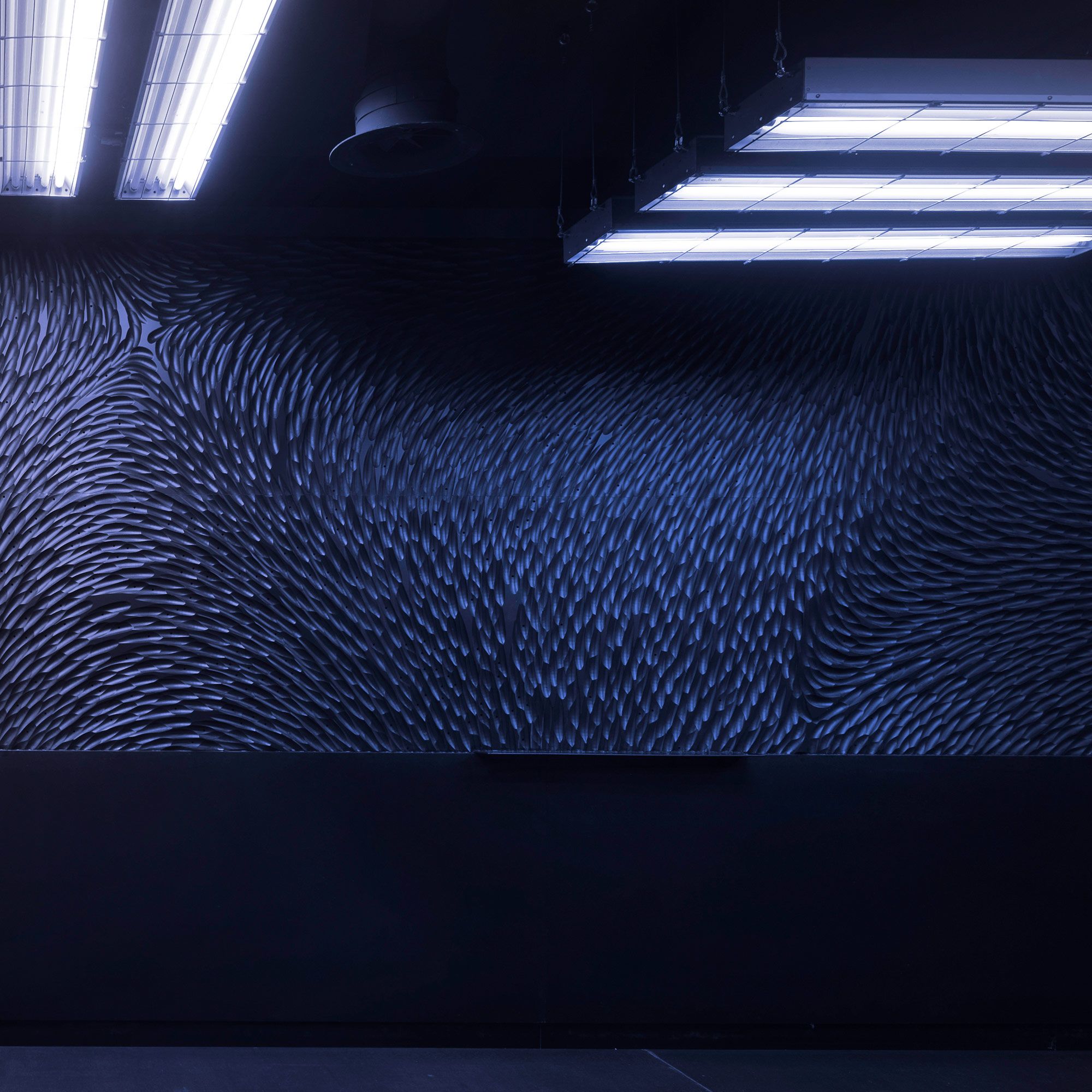

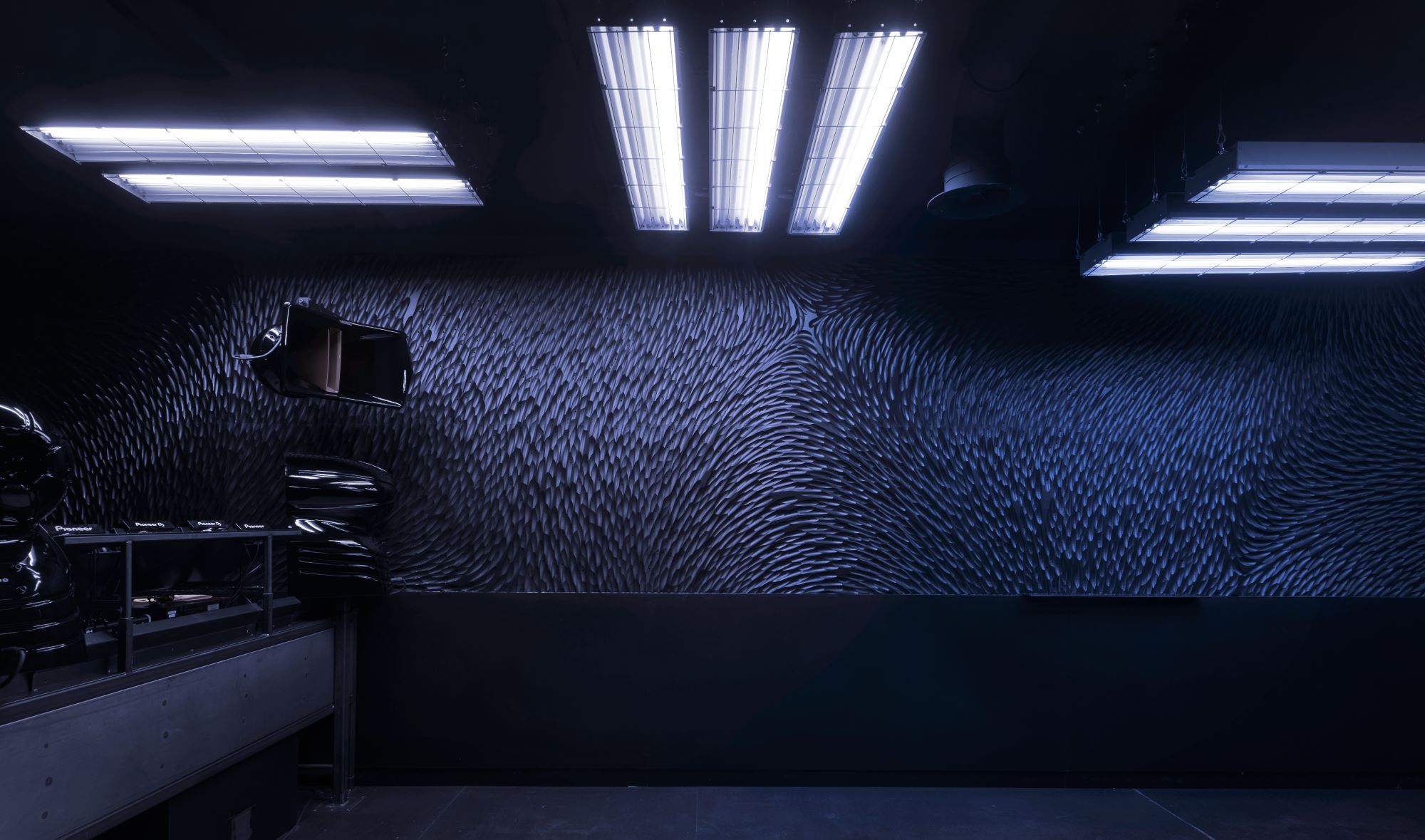
Blitz Club – Secondary Floor


Schäftlarnstrasse 10
DE-81371 München